

With UK festive online spending forecast to hit £28.52bn, retailers face a new contest for visibility, trust and conversion as shoppers turn to AI for gift inspiration and better deals.
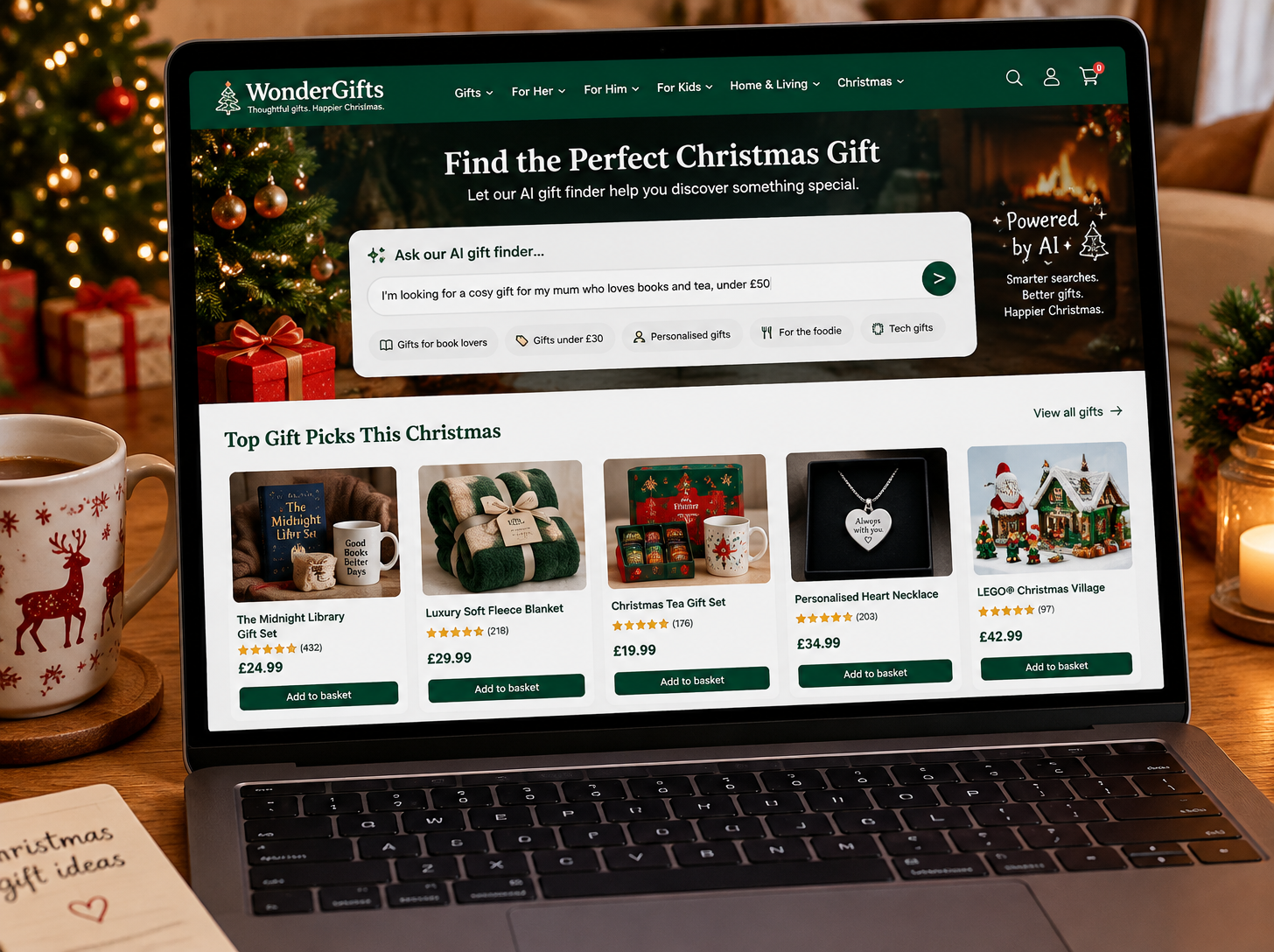
The battle for Christmas spending may begin before a shopper reaches a search engine, let alone a website. A request for a gift within a particular budget can now produce an AI-generated shortlist, this leaves brands with a new challenge – making sure they are on it.
The opportunity comes against a backdrop of forecast growth. Research from Adobe predicts UK shoppers will spend a record £28.52bn online between 1 November and 31 December, up 6.2 per cent year-on-year. Fourth-quarter ecommerce sales are expected to climb 6.4 per cent to £40bn.
AI is expected to play a bigger role in how that spending is directed. Adobe forecasts that traffic to retail websites from AI platforms will rise 214 per cent year-on-year during November and December, compared with a 111 per cent increase in September.
That does not mean AI is responsible for the overall increase in sales, or that shoppers are ready to hand over their wallets to autonomous assistants. The research and industry commentary point to a more nuanced shift. AI is helping consumers decide what to buy, while retailers work out how to be recommended, and how to turn that recommendation into a completed order.
A new route to the Christmas shortlist
PayPal research finds that 35 per cent of UK consumers are already using, or planning to use, AI to help with their Christmas shopping. Finding deals or comparing prices is cited by 52 per cent, while 51 per cent point to product research. Personalised gift recommendations and identifying this year’s must-have presents each attract 39 per cent.
Dave Jones, head of UK consumer at PayPal, describes shoppers as “embracing new ways to make their lives easier”, including “using AI to compare deals and take some of the stress out of Christmas and gift buying”.
These more detailed requests could reveal needs that a conventional search leaves unclear. Simon James, managing director of AI & data strategy at Publicis Sapient, says: “The average Google search is four or five words. The average AI prompt is around twenty. That gives retailers a much richer picture of intent, because you start to understand the ask behind the ask.”
He points to B&Q’s assistant as an example of helping customers work out what they need for a project, rather than simply directing them to an individual product. The potential commercial benefit is a fuller basket, although that remains an opportunity rather than a guaranteed outcome.
Winning a recommendation, not just a click
The shift creates a different kind of competition for visibility. Tom Bowie, co-founder at Ignite Stack, says its research with Visible PR analysed 600 AI-generated answers to Christmas gifting questions. John Lewis appeared in around one in five responses, while Monica Vinader, LEGO and Hampers.com led their respective gifting categories.
“It’s no longer just about competing on price, advertising or search rankings,” Bowie notes. “Brands also need to make sure they’re appearing in the AI recommendations that increasingly influence what shoppers consider buying.”
Those findings describe visibility within the answers studied, not a share of Christmas sales. But they illustrate why retailers are paying attention to the point at which consumers assemble their shortlist.
Cathy Farmer, head of GEO at Third City, argues that retailers need to answer specific needs rather than rely on broad promotional language.
“Someone asking for a gift for a particular person, budget and interest needs a useful recommendation, not a page of generic claims,” she says. “I’d focus on clear product information, up-to-date availability and credible independent coverage that helps explain who a product is right for.”
This does not make other marketing channels irrelevant. Adobe also forecasts that revenue share from social networks will rise 24 per cent, with influencer partnerships up seven per cent. Jack Rigby, founder of PR Barn, argues that media coverage, social referrals, reviews and an easy-to-search website all contribute to AI visibility.
Farmer cautions: “A place in an AI answer is worth checking, but it isn’t a sale. Retailers need to look at what happens next: visits, purchases and whether those customers come back.”
The sales impact may be harder to track
Measuring those outcomes presents another challenge. Daisy Wolfenden, managing director at Wolfenden, reports strong growth in revenue coming directly from AI platforms across its retail clients, while stressing that it remains a small proportion of overall sales.
“AI is influencing which retailers consumers discover, which products they consider and ultimately where they spend, but much of that influence won’t be reflected in direct referral revenue,” she says. “A customer might discover a brand through ChatGPT and then purchase through Google or directly with the retailer.”
That distinction matters when assessing AI’s contribution this Christmas. Referral traffic can show one route to a purchase, but Wolfenden’s point is that discovery and checkout may happen in different channels. Looking only at sales attributed directly to an AI platform could miss some of its influence.
Conversational tools may also help explain why shoppers do not buy. James says an assistant can capture where a conversation stopped and which questions went unanswered, exposing barriers such as delivery charges.
“Web analytics only ever showed clicks,” he says. “This starts to show you people’s motivations and barriers.”
Related Story

Discovery is ahead of delegation
Growing use of AI for inspiration should not be confused with a willingness to let it spend. Research from Signicat highlights how trust changes with the task: 42 per cent of consumers would trust AI to create recipes and 38 per cent to draft emails, but only eight per cent would be happy for it to make high-value purchases on their behalf. For smaller purchases, the figure is 19 per cent.
The research also finds discomfort with AI making purchases on a consumer’s behalf at 69 per cent, close to the 71 per cent recorded for opening financial products. That points to a boundary between seeking advice and allowing a tool to make financial decisions.
Mark Howell, director of EMEA retailers at Rithum, puts the distinction plainly: “The biggest impact of AI right now isn’t autonomous purchasing, its discovery. People are increasingly using AI tools as search engines.”
This switch therefore makes a stronger case for improving discovery and decision-making than for assuming shoppers will delegate the entire transaction.
The promise has to survive checkout
Even a well-targeted recommendation can fall short if the retailer cannot fulfil it. Product data, availability and the checkout experience connect AI-led discovery to actual revenue.
Joe Squire, marketing director at Epos Now, describes a shopper asking an assistant to find a gift under £40 that can be collected that day. In that scenario, he argues, accurate, connected stock information becomes crucial.
“That makes a retailer’s stock data its new shop window,” he notes. “An independent shop with a website and a till that don’t talk to each other risks being invisible at exactly the moment a shopper is ready to buy.”
The next hurdle is completing the order. Nikhita Hyett, EMEA general manager at Signifyd, says: “If AI helps someone find the right product at the right price, only for their order to be declined at checkout, the entire experience falls apart.”
Her warning is that fraud checks must distinguish genuine purchases from risky ones as shopping journeys change. Behind the transaction, staffing also matters: Kristján Freyr Kristjánsson, co-founder and CEO of 50skills, argues that automating contracts and onboarding can help retailers get seasonal workers ready sooner, allowing fulfilment to keep pace with customer expectations.
AI’s impact on UK ecommerce this Christmas is therefore unlikely to be captured by one traffic-growth figure. The forecasts suggest a fast-growing route into retail websites; the consumer research shows demand for help with prices, products and presents, alongside continuing reluctance to surrender control of purchases.
The opportunity is not simply to appear in more AI answers. It is to be recommended for the right reasons, offer the product the shopper actually needs and make the purchase work. A place on the Christmas shortlist is valuable — but the sale still has to be earned.
Click here to sign up to Retail Gazette‘s free daily email newsletter